
 English
 Español
 日本語
 العربية
 繁体中文
 简体中文


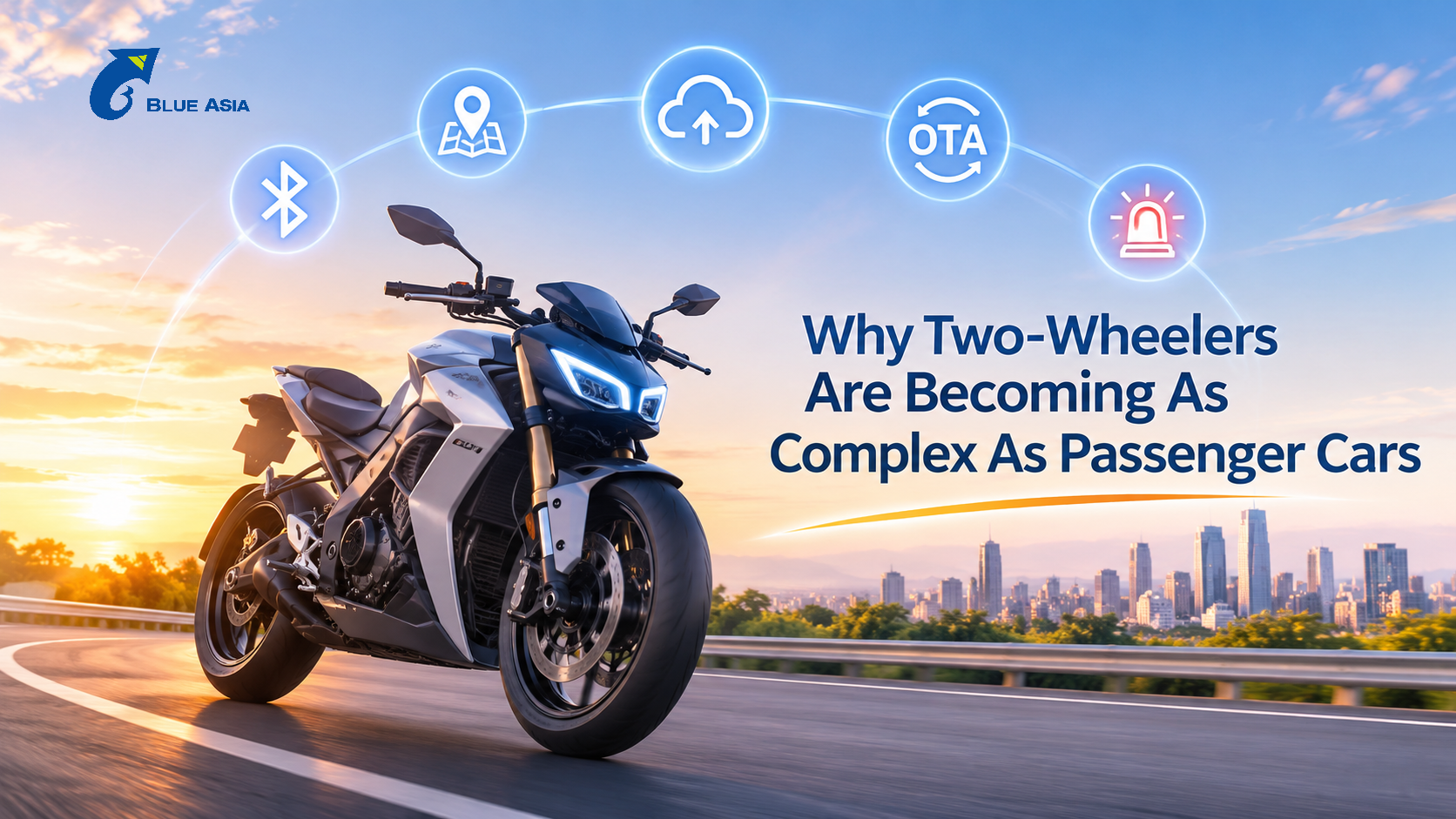
Why Two-Wheelers Are Becoming As Complex As Passenger Cars
Why Two-Wheelers Are Becoming As Complex As Passenger Cars
Modern motorcycles are no longer simple machines.
For many years, motorcycles were viewed as mechanically simple vehicles.
Compared with passenger cars, they contained fewer electronic systems, limited connectivity and relatively straightforward development processes.
That picture is changing rapidly.
Today's motorcycles, scooters and e-bikes are becoming highly connected digital products.
They are no longer defined only by engines, batteries or suspension systems.
Increasingly, they are defined by software, connectivity and electronics.
And that is changing how manufacturers approach engineering and compliance.
Two-wheelers are entering the connected era
Modern two-wheelers increasingly include features such as:
Bluetooth connectivity
Smartphone integration
TFT displays
Turn-by-turn navigation
Cloud-connected mobile apps
OTA software updates
Ride data synchronization
Remote diagnostics
Emergency assistance functions
Many of these technologies were once available only in premium passenger cars.
Today, they are becoming standard expectations for connected motorcycles and electric scooters.
More electronics means more integration challenges
Adding new electronic features sounds straightforward.
In reality, every new function interacts with existing systems.
For example:
A Bluetooth connection may need to work alongside navigation audio.
A mobile application may synchronize through cloud services while the dashboard is updating.
An OTA update may modify software without changing the hardware.
A rider assistance function may rely on multiple sensors working together.
The challenge is no longer developing one feature.
It is ensuring every feature works reliably as one integrated system.
Compliance is becoming more complex
Traditional motorcycle compliance focused primarily on vehicle safety and basic electrical performance.
Connected motorcycles introduce additional engineering considerations.
Manufacturers now need to evaluate topics such as:
Wireless communication performance
Software lifecycle management
Configuration control
System integration
Connected services
Product traceability
As electronics become central to vehicle performance, compliance increasingly extends beyond hardware testing.
Software is becoming part of the vehicle
A motorcycle is no longer a product that remains unchanged after production.
Software now continues to evolve through:
OTA updates
Feature improvements
Navigation enhancements
Mobile application updates
Performance optimization
This means manufacturers must manage not only hardware quality, but also software consistency throughout the product lifecycle.
The product riders purchase today may continue improving long after it leaves the factory.
Global markets create new challenges
Many motorcycle manufacturers now develop products for multiple international markets.
One platform may be sold in Europe, Asia, the Middle East and other regions.
Although the hardware may be similar, regional requirements can differ.
Engineering teams increasingly need flexible software configurations, localization strategies and scalable compliance planning.
Global expansion now depends as much on platform adaptability as on mechanical performance.
Future development requires system thinking
The next generation of motorcycle engineering is no longer only about mechanical design.
Successful development increasingly requires collaboration across:
Vehicle electronics
Embedded software
Wireless technologies
Cloud connectivity
Mobile applications
Compliance engineering
This shift mirrors the transformation already taking place in passenger vehicles.
As two-wheelers become smarter, system engineering becomes just as important as traditional vehicle engineering.
Five questions every motorcycle manufacturer should ask
Before launching a connected two-wheeler, consider:
✅ Can the software be updated safely throughout the product lifecycle?
✅ Have wireless technologies been validated as an integrated system?
✅ Can future features be added without redesigning the platform?
✅ Is compliance considered during product planning?
✅ Can the platform support multiple regional markets?
These questions will increasingly determine long-term product success.
Final Thoughts
The future of motorcycles is not only electric.
It is connected.
As motorcycles, scooters and e-bikes become increasingly digital, they are beginning to face many of the same engineering and compliance challenges as passenger cars.
The companies that succeed will not simply build better vehicles.
They will build better connected platforms that combine software, electronics and compliance into one integrated development strategy.
Because modern two-wheelers are no longer simple machines.
They are becoming intelligent connected vehicles in their own right.
Join the discussion
How do you see the future of connected motorcycles?
Will software and connectivity become as important as mechanical performance over the next decade?
I'd love to hear your thoughts in the comments
 Blog
Why Two-Wheelers Are Becoming As Complex As Passenger Cars
Lire l'article
 Blog
Why Future Vehicle Certification Will Be Continuous Instead of One-Time Approval
Lire l'article
 Blog
Saudi SASO 2944 for Light Vehicles: How to Separate CST Module RF Approval from Vehicle-Leve
Lire l'article
 Blog
Adding 4G/5G eCall to an Existing Vehicle? The Hard Part Is Not the Cellular Module.
Lire l'article
 Blog
Apple CarPlay Audio Integration: How to Avoid Playback and Call Interference
Lire l'article
 Blog
DAB+ Receiver Validation: How to Manage Service Following and Station Information
Lire l'article

 4000259520